KCSiE 2026 and AI
What every member of staff needs to know about artificial intelligence and safeguarding, in one briefing.
Free for schools and colleges to use and share internally.
- Dr Will Van Reyk, St Paul's Girls' School
- August 2026
- Slides & summary
- 9 minutes
Artificial intelligence is now explicitly referenced in the safeguarding guidance that governs how schools define harmful imagery, categorise online risk, and train staff.
Paraphrased for briefing purposes. The full wording, with citations, appears in the briefing.
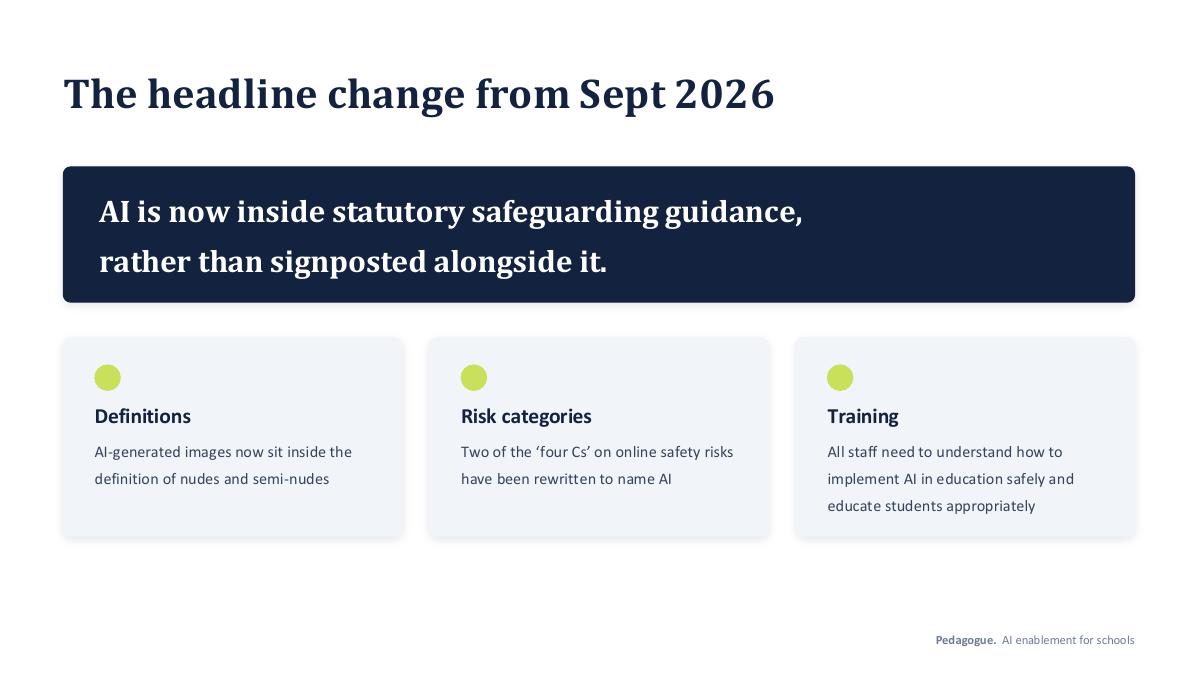
AI is now inside statutory safeguarding guidance, rather than signposted alongside it.
Three things changed
01
Definitions
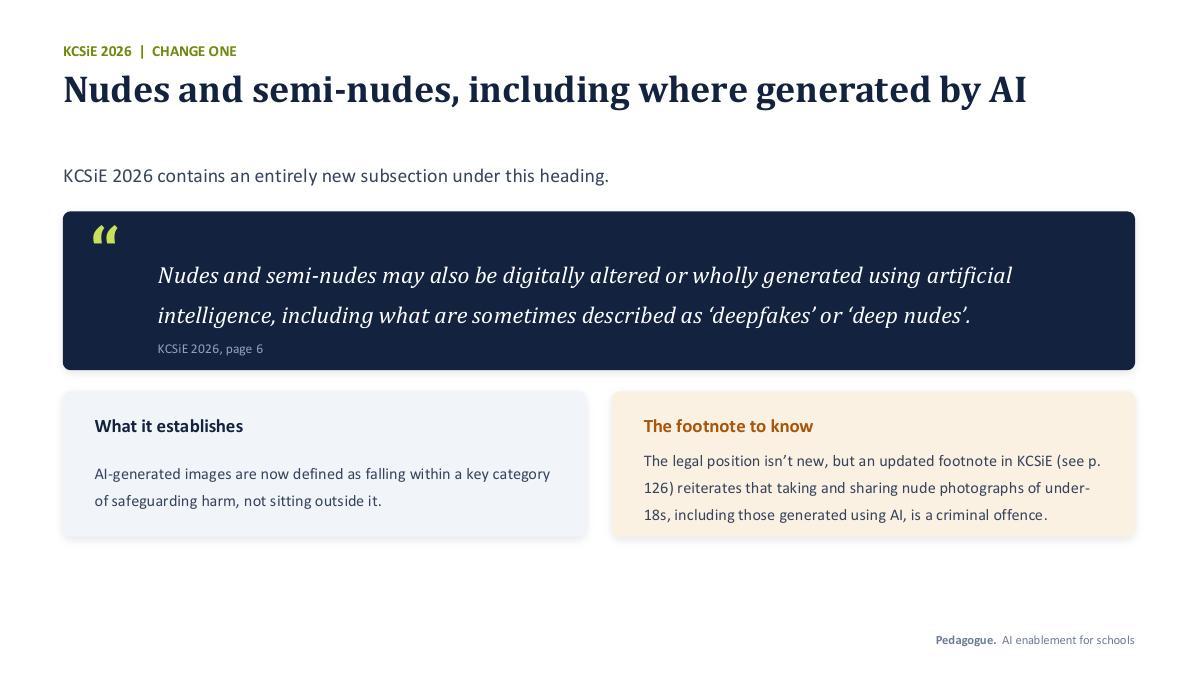
AI-generated images are now explicitly included within the definition of nudes and semi-nudes.
02
Risk categories
Two of the four online-safety risk categories — Contact and Conduct — have been rewritten to refer explicitly to AI.
03
Staff awareness
AI-related risk now forms part of the material staff encounter in Part One and in wider safeguarding and online-safety training.
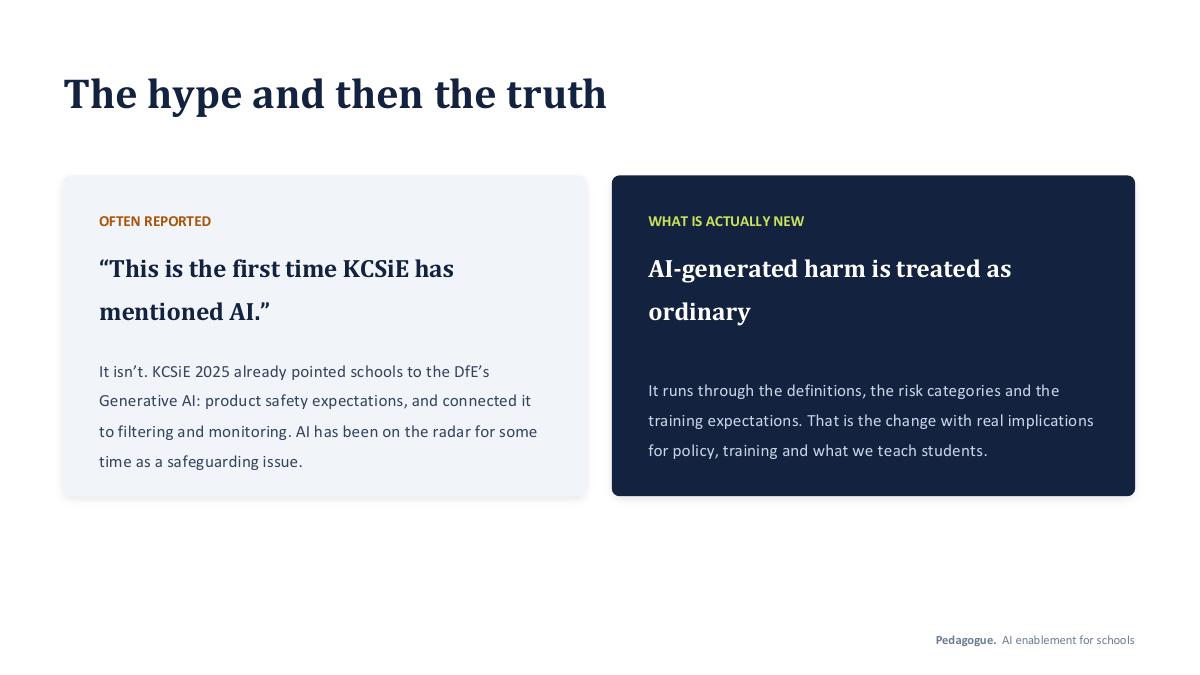
Often reported vs what is actually true
“This is the first time KCSiE has mentioned AI.”
It isn't. AI was already on the safeguarding radar — what changed is where it sits.
“It only concerns deepfake images.”
The person can be real even when the image, video or audio is not, and the harm is treated the same either way.
“It is a matter for the DSL alone.”
Every member of staff needs to know how to respond, and what not to do, when a pupil reports an AI-generated image.
What this means in practice
Ensuring that policy, training and curriculum reflect the updates and revised wording.
A shared understanding of AI harms and risks, especially what to do — and what not to do — when a pupil reports an AI-generated image.
Teaching that safeguards students and educates them about AI harms.
Inside the briefing
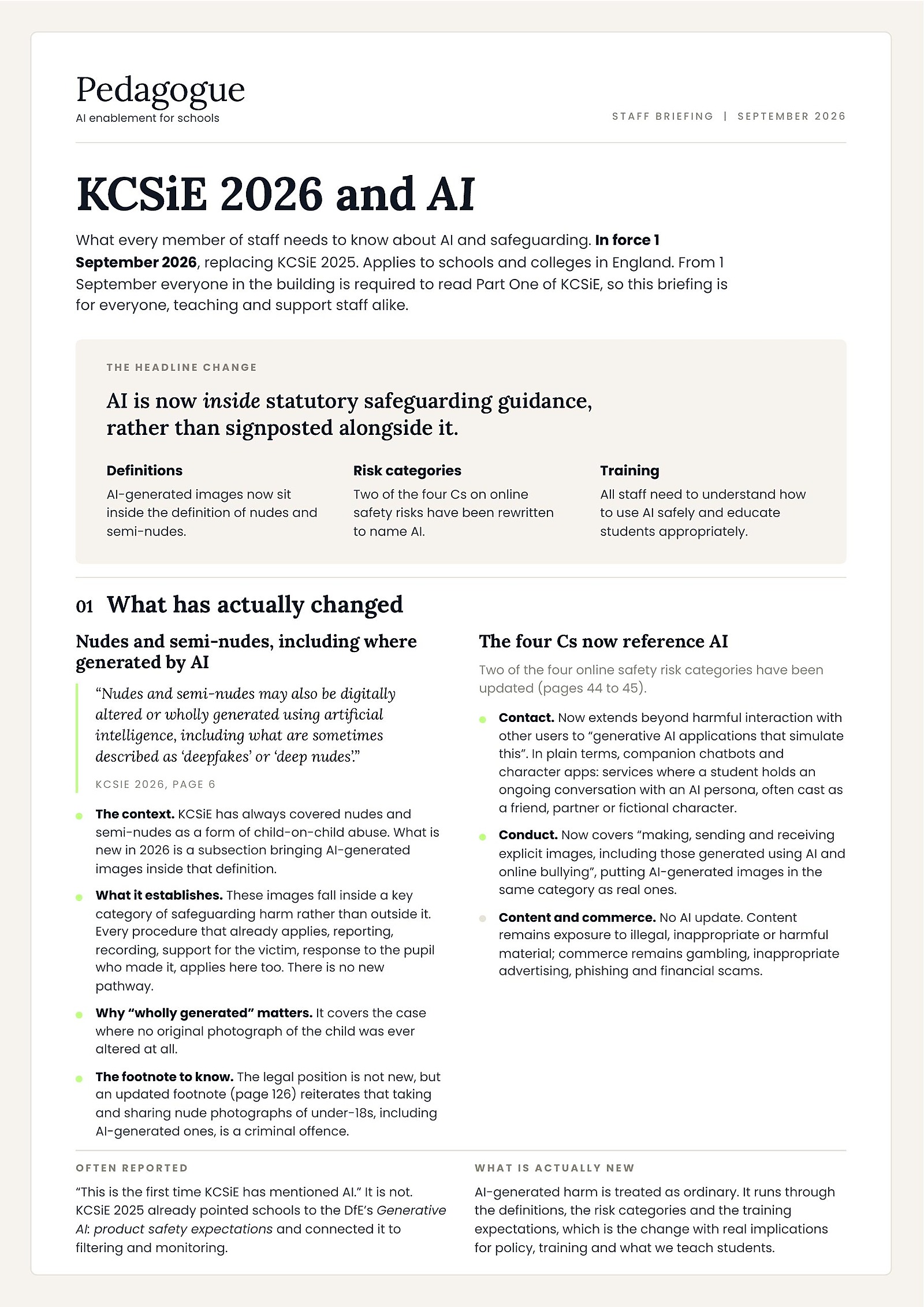
The two-page staff summary
The same material reduced to a printable reference for briefing colleagues or circulating ahead of September training.
Get the free KCSiE 2026 staff briefing
Enter your school email — both resources open immediately, no waiting for approval.
The email usually arrives within a few minutes — if it has not appeared after three minutes, please check your junk or quarantine folder.
We use your email to send the briefing and store your enquiry. See our privacy policy and cookie policy.
Dr Will Van Reyk
Deputy Head, Director of Innovation at St Paul's Girls' School in partnership with Pedagogue's editorial team.
Pedagogue builds staff AI capability in schools — practical development, leadership visibility and school-ready resources, so that responsible AI use becomes part of everyday school life.
How Pedagogue worksFree for schools and colleges to use and share internally.